


Paracord : A Complete Guide to Applications, Types and Uses for Survival and Crafts
If you are passionate about outdoor adventures, survival or creative projects, there is one material that cannot be missing from your kit: paracord . But we are not talking about just any rope!
Paracord is one of the most versatile, durable, and useful resources you can have, whether you’re camping, hiking, or even working on craft projects.
Imagine having a rope with you at all times that can support impressive weights, resist the elements, and transform into an infinite number of tools to face any emergency. From creating makeshift shelters to bracelets that can save your life, paracord is the answer to a wide range of needs.
In this article, I’ll walk you through everything you need to know about this incredible material: how to choose it, how to use it in survival situations, and even how to customize your knife with a comfortable, durable handle.
Ready to find out how paracord can become your most powerful ally? Keep reading!
The term “paracord” is a contraction of “parachute cord,” which in Italian can be translated as “parachute rope.”
Paracord is a strong, versatile type of rope that was originally used for military purposes, but has become popular in many other applications as well.
It is made of braided nylon and usually has a high resistance. Paracord is known for its durability, light weight and ability to hold a considerable load.
People use paracord for a variety of purposes, such as survival in extreme situations, hiking, camping, making bracelets, belts, straps, and many other craft projects.
This rope is also appreciated for its versatility, as it can be dismantled to obtain internal strands that can be used for various other applications.
Paracord is a strong and versatile nylon cord originally designed for military purposes, but also widely used in many other situations.
What is paracord?
You’ve heard about paracord from everyone and want to know what it is.
Or you may have friends who are into paracord and are trying to explain it to you. Either way, it helps to have a deeper understanding of what paracord is and why it is so popular.
Paracord is an extremely strong and versatile rope that has its origins in military use.
The term “paracord” comes from the contraction of “parachute cord,” which in Italian can be translated as “parachute rope.”
Initially, this rope was mainly used in military equipment for paratroopers, due to its reliability and strength.
The main reason paracord has become so popular outside of the military is its versatility. This rope is made by braiding several nylon strands together, which makes it very strong.
Its tensile strength can vary depending on the type and grade of paracord, but many variations can support considerable weight.
People use paracord for a wide range of purposes.
It has become a favorite material for outdoor enthusiasts, such as hiking, camping, and survival, as it can be used to build shelters, tents, survival belts, and more.
Additionally, it is a popular choice for crafts, where people create bracelets, pendants, belts, and other decorative items with paracord.
The rope can also be dismantled to obtain thinner internal threads which are useful for sewing, repairing objects or for other applications.
Paracord comes in a variety of colors and styles, making it even more appealing to those who like to customize their projects.
Paracord is much more than just rope; it has become a hobby and a versatile material widely used in a variety of contexts, from survival to crafts.
So, if you are interested in learning more about this fascinating rope and how to use it, you are in the right place.
Nylon
Paracord was made possible by the invention of nylon in 1935 by Wallace Hume Carothers for DuPont. Initially, this synthetic fiber was used to make toothbrushes and nylon stockings for women.
Subsequently, during World War II, much of the nylon production was diverted to the war effort.
Nylon became an excellent substitute for silk in the making of parachutes and parachute cords, since silk, not being a synthetic material, had to be imported from Japan, which posed obvious logistical problems, especially considering that the United States was at war with Japan.
Nylon proved to be a durable and cheap substitute. After the war, 80% of the world’s nylon production went back to the production of women’s stockings and lingerie. (Hence the subtitle “A Brief History.” Um, um. Okay, don’t laugh.)
Nylon, being a synthetic material, has some important properties. It is resistant to rot, mildew, abrasion and weakening caused by UV rays.
This means that, unlike most naturally occurring materials, nylon can be exposed to weather, wear and tear and the passage of time without showing excessive deterioration.
Additionally, nylon dries quickly, has some stretch, and is much less likely to retain unpleasant odors, making it ideal for activewear.
Paracord
Paracord, which shares all the advantages of being made of nylon, was originally commissioned by the military. You can read the actual specifications below.
Many people often don’t know that there are officially 6 different types of paracord. If you’re thinking, “Oh no, I’ll never figure this out,” don’t worry. Most people, when they talk about paracord, are referring to Type III, commonly known as 550 cord.
Paracord is known for its strength, abrasion resistance, UV resistance, and its ability to dry quickly, thanks to the fact that it is made of nylon.
Initially, it was developed for military purposes, where it had to withstand extreme conditions and perform a variety of tasks, including tent construction, anchoring and support in various survival situations.
In reality, there are several different types of paracord, each with specific characteristics designed for particular purposes.
However, when people commonly talk about “paracord,” they are usually referring to Type III, known as “550 cord.”
This type of paracord is so called because it has a tensile strength of about 550 pounds (about 250 kg). It is very versatile and is widely used for a variety of applications, from outdoor to craft.
So, while there are various types of paracord with different specifications, you can feel safe using Type III, known as 550 cord, for most projects and needs.
Here is an overview of the various types of paracord used by the U.S. military, along with their strength and stretch:
| Type | Resistence | Stretching |
|---|---|---|
| Type I | 95 lbs | 30% |
| Type IA | 100 lbs | 30% |
| Type II | 400 lbs | 30% |
| Type IIA | 225 lbs | 30% |
| Type III | 550 lbs | 30% |
| Type IV | 750 lbs | 30% |
As you can see, each type of paracord has a different strength in terms of the weight it can hold, but they all share a 30% elongation.
Type III, known as “550 cord,” is the most common and is often used for a wide range of applications due to its 550-pound strength, making it a versatile material for many situations.

The document lists many other requirements and tests that paracord must meet, which leads to an important point:
Not all paracord on the market meets these requirements. Just because you see paracord labeled “Type III, 550 string” does not guarantee that it meets actual military specifications. Not all paracord labeled “Mil Spec” is necessarily true military specification either.
However, this does not mean that all non-military paracord is completely useless. It simply means that you should proceed with caution and not rely on it in critical situations where your safety depends on it.
Anatomy of Paracord
The anatomy of paracord is composed of two main parts: the core (kern) and the mantle (mantle) .
- Core (Kern): The core of the paracord is the inner part and is made up of twisted strands. In the case of Type III paracord, the most common, the core is made up of 7 strands. Each strand can be further broken down into 3 thinner strands. This core provides the main strength and resistance of the paracord.
- Mantle: The mantle is the outer part of the paracord and is made up of a braid of strands around the core. In the case of Type III paracord, there are usually 32 strands braided into the mantle. The mantle provides protection to the core, increases the overall strength of the paracord, and affects the external appearance.
Soul + Lining = “Kermantle”
The core of 550 paracord is usually made up of 7 strands, which in turn are made up of 3 smaller strands each. Military-spec cords will have a manufacturer’s identification cord inside, but beware: there are many imitations that use identification cord that does not meet true military specifications. If you are buying paracord as a survival cord and plan to carry your own weight, you should buy from a reputable seller.
The outer sheath is usually made of 32 strands twisted together. Although many different colors can be used for the different strands, “rainbow” colored paracord is usually not made of nylon, as individual nylon strands cannot be dyed multiple colors.
Different types of paracord have different specifications. If you want information on each type of paracord in the form of a visual comparison of size and construction, continue reading the post.
The bonding of the core and the sheath creates the “kermantle” structure of paracord. This structure gives paracord its strength, durability, and versatility. It is important to note that there are different types of paracord with different specifications, which means that the exact composition of the core and sheath can vary depending on the type of paracord used.
Paracord is known for its strength, its ability to withstand heavy weights, and its usefulness in a variety of situations, from survival to crafts. Understanding its anatomy is important to understand how to best utilize its characteristics in different applications.
For knives, choosing Paracord will depend on the specific use you intend to make of it and your personal preferences. Here are some considerations:
- 550 Paracord: This is the most common type of Paracord and is widely used for knife handles. It has a tensile strength of 550 pounds and is strong enough for many purposes. It comes in a variety of colors, making it ideal for customizing the look of your knife.
- 750 Paracord: If you need extra strength for heavier applications or larger knives, 750 Paracord might be a better choice. It is thicker and has a tensile strength of 750 lbs.
- 325 Paracord: If you want a thinner cord for your knife handle or if you are making a smaller knife, 325 Paracord might be a good option. It is thinner but still strong enough for many applications.
- 425 Paracord: This is a compromise between 550 and 325 in terms of thickness and strength. It can be a versatile choice for knife handles.
Also, consider the color and design of the Paracord based on your aesthetic taste and the overall design of the knife. Remember that Paracord can also be used for other knife-related purposes, such as making sheaths or ties for cases. So, choose the type of Paracord that best suits your specific needs and style.
Regarding the use of Paracord for knives, I would like to add a few additional considerations:
Design and Style: In addition to strength and color, also consider the design and style of the Paracord. There are various braiding patterns that can add a comfortable grip and a unique aesthetic to the knife handle. You can experiment with different braiding patterns to get the look you want.
The design and style of the Paracord weave are important aspects to consider when customizing your knife handle.
Here are some additional thoughts on this topic:
- Weave Patterns: There are numerous Paracord weave patterns to choose from, each with its own look and level of complexity. Some common patterns include cobra weave, fishtail weave, king cobra weave, and many more. Experiment with different patterns to see which one best suits your knife and your personal taste.
- Contrasting Colors: You can create an eye-catching design by using contrasting colors or combining different shades of the same color. This choice allows you to highlight the braiding pattern and make the knife handle more visible.
- Decorative Details: For an added decorative touch, consider adding beads, charms, or other details to your braided paracord. These details can add personality and uniqueness to your knife.
- Comfort and Functionality: In addition to aesthetics, make sure the weave provides a comfortable and secure grip for using the knife. Some weave designs may be more comfortable than others based on shape and texture.
- Tutorials and Resources: If you are new to paracord weaving, there are many online tutorials and resources available that will show you step by step how to create different weaving patterns. These resources can be helpful in gaining new skills and inspiration.
Paracord weaving offers many creative opportunities to customize the handle of your knife.
Explore different patterns, colors and decorative details to create a design that meets both your functional needs and your aesthetic taste.
Length: Make sure you cut the Paracord to the right length for your knife handle. A Paracord that is too short may not provide a secure grip, while a Paracord that is too long may be cumbersome. You may also want to consider braiding multiple layers of Paracord to create a thicker or different sized handle.
Here are some additional considerations:
- Accurate Measurement: Before cutting the Paracord, carefully measure the length of Paracord needed for your knife handle. You can do this by wrapping the Paracord around the handle or using a tape measure.
- Consider the Weave: Some weave patterns will require more Paracord than others. For example, a more complex weave may require more lengths of Paracord than a simple weave.
- Thickness Choices: Also consider the thickness of the Paracord and the comfort of the grip. A thicker Paracord will provide a sturdier grip, while a thinner Paracord may be more comfortable for some people.
- Multiple Layers: If you want a thicker or different sized handle, you can braid multiple layers of Paracord together. This allows you to further customize the length and thickness of the handle.
- Practice and Adjustment: It may take some trial and error to determine the optimal length of Paracord for your knife. Feel free to experiment and adjust until you find the configuration that gives you the best grip and comfort.
The length of the Paracord on the knife handle is a crucial aspect to ensure a secure and comfortable grip.
Take the time to carefully measure and cut your Paracord so that it fits your needs perfectly.
Maintenance: Paracord is durable, but it may wear out over time due to wear and tear and exposure to the elements. Be sure to regularly inspect the Paracord on the knife handle for any signs of damage or wear. If it shows excessive wear, you may need to replace it.
Here are some important maintenance considerations:
- Regular Inspection: Periodically inspect the Paracord on the knife handle for signs of damage or wear. This includes checking for cuts, tears, or loose threads. A quick inspection can prevent more serious problems in the future.
- Cleaning: If your knife is used in dirty or dusty conditions, it is important to clean the Paracord regularly. You can do this with warm water and mild soap, then dry the handle thoroughly. Make sure the Paracord is completely dry before storing the knife.
- Replacement: If you notice any obvious signs of wear or damage to your Paracord, it is a good idea to replace it. The strength of your Paracord may be compromised if it is damaged, which could make your handle less reliable.
- UV Protection: If your knife is frequently exposed to the sun, consider using a treatment to protect the Paracord from UV damage. This can help preserve its durability.
- Knife Maintenancec: Also, don’t forget to perform general maintenance on your knife, such as sharpening the blade and lubricating moving parts as needed. A well-maintained knife will perform better and last longer.
Regular maintenance will help ensure that the Paracord on your knife handle remains in tip-top condition to provide a secure and reliable grip, as well as maintaining its aesthetic appearance.
Survival Accessory: Paracord can also serve as a useful survival resource when you are in outdoor situations. You can weave a Paracord string on your knife so that it is always handy in case of emergency.
The use of Paracord as a survival accessory is one of its most interesting features.
Here are some additional considerations on how to leverage Paracord as a survival resource with your knife:
- Survival Lanyard: You can weave a Paracord cord directly into the handle of your knife so that it is always within reach in an emergency situation. This cord can be quickly unwound and used for a variety of purposes, such as building a makeshift shelter, setting a trap, or securing equipment.
- Cutting and Sealing: Paracord is known for its strength and durability. You can also use it to cut objects or seal cracks or wounds. It is helpful to have a sharp blade on your knife to separate the inner strands of Paracord for these applications.
- Emergency Rope: In survival situations, Paracord can be used to create emergency ropes for shelter building, securing items, or recovery. You can strip the inner strands of Paracord and braid them together to increase its length and strength.
- Signals and Identification: Paracord comes in a variety of colors. You can use your colored Paracord to create visual signals or to identify important objects or areas in a survival situation.
- Training: Before facing an emergency situation, it is advisable to practice with Paracord and learn the various techniques of use. Knowing the capabilities of Paracord and how to use it effectively can make the difference in survival situations.
Using Paracord as a survival accessory with your knife is a smart practice for anyone who spends time outdoors.
Make sure you know the different applications and techniques of using Paracord so you are prepared in case of an emergency.
Paracord can be a great material to enhance the grip and aesthetics of your knife, but it is important to consider the specific needs of your usage and personal style when choosing the type and design of Paracord.
Parachute and paracord
Nylon fabric and nylon paracord were the first synthetic materials used in the production of parachutes.
Did you know that the first person to jump with a nylon parachute was a daredevil named Adeline Gray?
Although advances have been made in parachute construction since World War II, nylon is still the most commonly used parachute material today.
This means that in 80 years we still haven’t found a better fabric that is as cheap to produce as nylon.
After an hour of searching the Internet, I have been unable to determine whether parachute suspension lines are still made of anything resembling paracord.
If anyone is an expert on the subject, let us know in the comments below! Either way, paracord has played an important role in the history of the United States military and beyond.
The Classic Survival Bracelet
Is it possible to write an article about paracord without mentioning the classic survival bracelet?
The “cobra” pattern is easily recognizable and has been the icon of paracord for many years.
This bracelet is known for its convenience in storing a large amount of paracord for emergency situations but some may find it a bit bulky for everyday use.
To overcome this problem, one solution might be to make bracelets with a thinner type of paracord.
The “lower” types, although slightly less durable, are still an extremely useful survival tool.
This choice could make the bracelet more suitable for everyday use, while still maintaining the functionality of having a significant amount of paracord on hand in case of need.
Another exciting option is making a paracord belt, a project that many paracord enthusiasts have yet to tackle.
A paracord belt offers the ability to have a considerable amount of rope on hand in a discreet and convenient way.
It is a design that combines functionality and style, offering both a useful accessory and the peace of mind of being prepared for emergency situations or outdoor adventures.
In conclusion, while the classic survival bracelet is undoubtedly an icon of the paracord world, there are other creative and practical options to explore.
Whether you opt for a thinner bracelet or a paracord belt, paracord offers endless possibilities to adapt its versatility to your needs and lifestyle.

Here are the most important points to keep in mind regarding paracord:
- Historical Significance: Paracord has a fascinating history that began in the middle of the last century. Originally designed for military purposes, it has been used by the armed forces for various applications, including making parachutes.
- Exceptional Strength: Paracord is known for its incredible strength and durability. It can withstand considerable load and resists abrasion, UV rays and mildew, making it a reliable material in many situations.
- Survival Use: Paracord is widely recognized for its survival applications. It can be used to build makeshift shelters, for emergency rescue, or to create tools and equipment useful in hostile environments.
- Versatility in Daily Life: In addition to emergency situations, paracord has numerous practical uses in everyday life. You can use it to create bracelets, belts, knife handles, key lanyards and much more. Its flexibility makes it a useful resource in many circumstances.
- Quality Differences: Not all paracord is created equal. There are various qualities and specifications of paracord, so it is important to be careful when choosing the type of paracord that best suits your needs. The actual quality of paracord can vary greatly between manufacturers.
- Climbing Caution: It is important to note that paracord is not designed for climbing or to support human weight in life-or-death situations. You should never trust your safety to paracord in these circumstances. It is important to use climbing ropes that are certified and designed for such purposes.
Paracord is a versatile material with a fascinating history and many applications but it is essential to be aware of its limitations and use it responsibly for your specific needs.
Rope Comparison Chart – Paracord Sizes
Why paracord?
Paracord is an excellent choice for many applications, especially in survival and emergency situations, for several reasons:
- High Strength : Despite its relatively small diameter, Paracord has an exceptionally high tensile strength. This means it can withstand a considerable load, making it useful for building makeshift shelters, tents, traps, and for creating survival tools and equipment.
- Compactness : Due to its small diameter, Paracord is easily portable and can be coiled compactly to fit into an emergency kit or even worn as a bracelet, ensuring you always have a survival resource on hand.
- Weather Resistance : Paracord is known for its resistance to decay and weakening caused by UV rays. This means that it can maintain its strength and durability even when exposed to the elements and sunlight for a long period of time.
- Versatilità: Il Paracord è incredibilmente versatile e può essere utilizzato per una vasta gamma di scopi. Oltre alle applicazioni di sopravvivenza, può essere utilizzato per la creazione di cinture, manici di coltelli, cordini per le chiavi, braccialetti, decorazioni e molto altro.
- Ampia Disponibilità: Il Paracord è ampiamente disponibile in molte varianti, tra cui diversi colori e tipi, ognuno con caratteristiche specifiche. Questa varietà consente di selezionare il Paracord più adatto alle tue esigenze.
Il Paracord è una risorsa preziosa che ha dimostrato di essere affidabile e versatile in molte situazioni.
La sua resistenza, compattezza e resistenza agli agenti atmosferici lo rendono un elemento essenziale per gli amanti delle attività all’aperto, gli appassionati di sopravvivenza e coloro che cercano un materiale affidabile per le loro esigenze di corda.
Che tipo di Paracord dovresti utilizzare?
Quando si parla di Paracord, spesso ci si riferisce al Paracord con una resistenza a trazione di 550 libbre, utilizzato nelle sospensioni dei paracadute militari e noto come “Type III” o “550 cord”.
Tuttavia, è importante sapere che ci sono diverse tipologie di Paracord, ognuna con caratteristiche specifiche, che rendono la scelta del tipo di Paracord importante a seconda delle tue esigenze.
Ecco una panoramica dei tipi di Paracord più comuni:
- Type I: Con una resistenza a trazione di circa 95 libbre, il Type I è il più sottile tra i tipi di Paracord. È leggero e adatto per progetti che richiedono una corda più sottile ma resistente, come braccialetti o cordicelle.
- Type II: Con una resistenza a trazione di circa 225 libbre, il Type II è un po’ più robusto del Type I ed è utile per una varietà di scopi, inclusi braccialetti e attività outdoor leggere.
- Type III (550 cord): Questo è il tipo di Paracord più comune. Con una resistenza a trazione di 550 libbre, è estremamente versatile e può essere utilizzato per una vasta gamma di scopi, tra cui escursioni, campeggio, sopravvivenza e artigianato.
- Type IV: Con una resistenza a trazione di circa 750 libbre, il Type IV è uno dei più resistenti tra i tipi di Paracord. È ideale per applicazioni in cui è richiesta una maggiore forza, come legare oggetti pesanti o creare attrezzi di sopravvivenza robusti.
È importante scegliere il tipo di Paracord in base alle tue esigenze specifiche. Ad esempio, se stai creando un braccialetto Paracord sottile, il Type I potrebbe essere la scelta migliore.
Se stai pianificando un’escursione o un’attività all’aperto, il Type III (550 cord) è una scelta affidabile. Inoltre, tieni presente che ci sono anche altre varietà di Paracord, come il Paracord elastico (shock cord) per applicazioni specifiche.
Choosing the right Paracord for your project or needs is crucial to ensure that it is strong enough to perform the desired task.
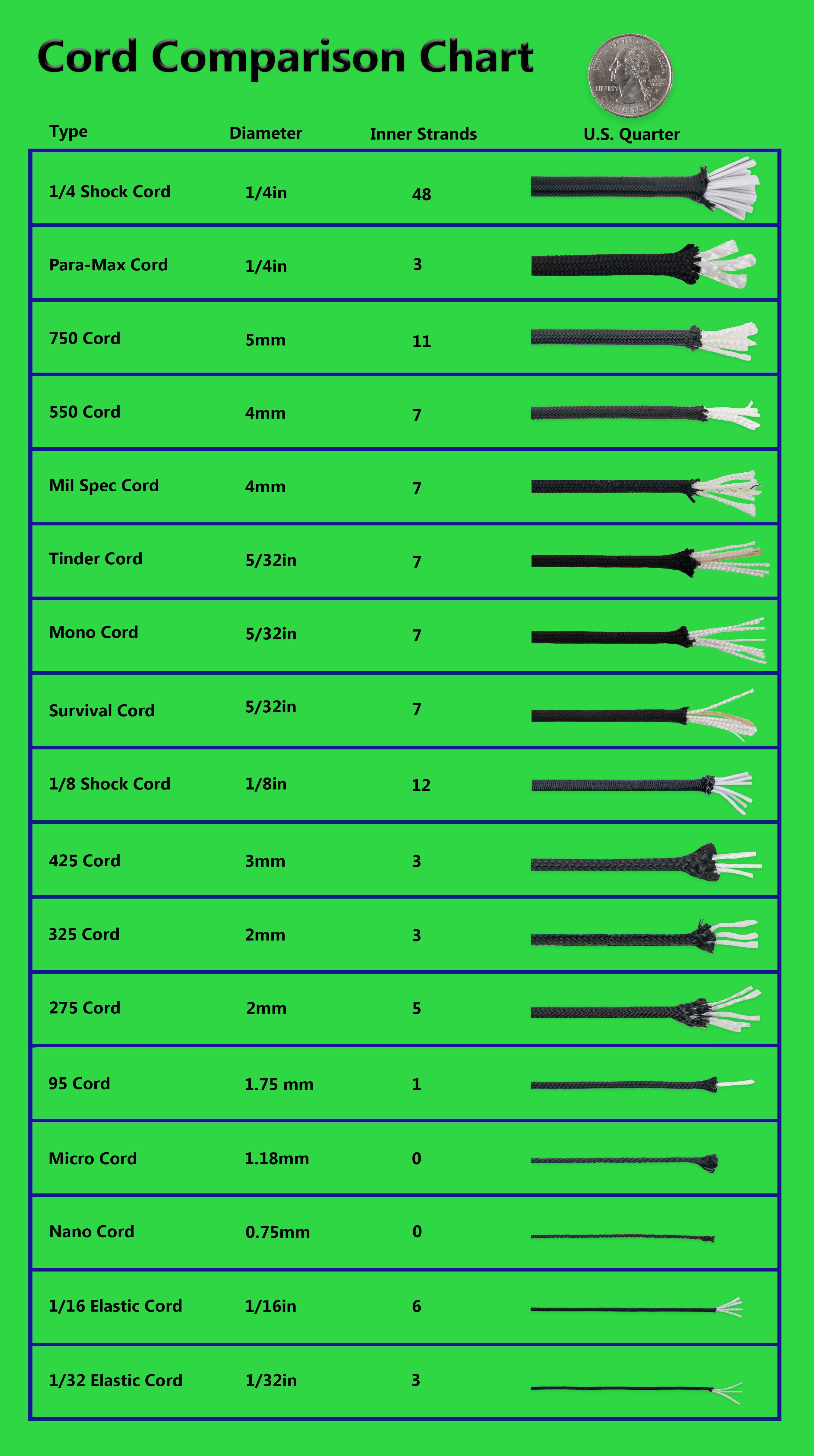
The Paracord 550
Paracord 550 is the most popular variety because it offers a great balance between strength and flexibility. It has countless uses and is perfect for bracelet making, clothing repairs, handle wrapping, as well as hunting, fishing, and camping.
Standard 550 Paracord is military specification cord (cord that has passed the most rigorous tests for strength and durability).
Here are some specifications of the Paracord 550:
- Certified as Type III Nylon Paracord
- Tensile strength of 550 lbs
- Diameter of 4 mm
- 7 internal threads
These features make Paracord 550 a versatile and reliable choice for a wide range of applications, from survival to crafts and the outdoors.
Its strength and flexibility make it an indispensable tool for outdoor enthusiasts and anyone who wants a sturdy, ready-to-use rope.
Dwarf Paracord
Nano Paracord is the thinnest cord, but it has its uses. Its small size means that large quantities can be stored in a very small space. This small cord can be used to make bracelets and smaller jewelry, as well as for some emergency situations where high strength is not needed.
Here are some specifications of the Nano Paracord:
- Certified as Type I Nylon Paracord
- Tensile strength of 36 lbs
- Diameter of 0.75 mm
- No internal thread
Despite its small size, Nano Paracord has its place, especially for craft projects that require a thin cord.
It can be an ideal choice for creating more delicate and detailed bracelets, as well as being easily portable as part of a lightweight survival kit.
Its flexibility and compactness make it a valuable resource for certain applications.
Micro Paracord
Micro Paracord is perfect on its own or paired with our 550 Paracord to add a pop of color to any Paracord weave pattern.
It’s a sturdy little cord that has just as many potential uses as our popular 550 Paracord.
Favorite uses for Micro Paracord are for Paracord necklaces and braided cobra bracelets with laces.
Here are some specifications of the Micro Paracord:
- Certified as Type I Nylon Paracord
- Tensile strength of 90-100 lbs
- Diameter of 1.18 mm
- No internal thread
Micro Paracord is ideal for craft projects that require a thin yet strong cord.
Its strength makes it suitable for many applications, including creating Paracord necklaces for a touch of style and extra strength.
It is an excellent choice for those looking for versatility and creativity in their Paracord weaving projects.
Paracord 95
Paracord 95 fits between our Paracord 275 and Micro cord. Although it is thicker than Micro cord, it has the same tensile strength.
It has a single internal thread, making it a highly flexible cord.
This thin cord is used for countless projects, such as macramé, bracelets, music boxes and many other braiding projects.
Here are some specifications of the Paracord 95:
- Certified as Type I Nylon Paracord
- Tensile strength of 100 lbs
- Diameter of 1.75mm
- 1 internal thread
Paracord 95 is perfect for projects that require a thin yet strong cord.
Its flexibility makes it ideal for macramé and other forms of artistic weaving.
It is an excellent choice for craft enthusiasts looking to add a touch of creativity and durability to their projects.
Paracord 275
Paracord 275 is unique because it is one of our stiffest Paracords.
It contains 5 internal wires within its 2mm sheath and is approximately 7 inches long when fully extended.
This thin cord is great for crafts and repairs.
This works especially well for small Paracord projects like kids bracelets, keychains, and lanyards.
Here are some specifications of the Paracord 275:
- Certified as Type II Nylon Paracord
- Tensile strength of 275 lbs
- Diameter of 2 mm
- 5 internal threads
Paracord 275 is ideal for craft projects that require a stiffer but stronger rope.
Its durability makes it suitable for a variety of projects, from children’s bracelets to keychains and lanyards.
It is an excellent choice for those looking for a versatile Paracord for small projects.
Paracord 325
Paracord 325 represents a happy compromise between Micro cord and traditional Paracord 550.
It is perfect for projects where you need a thinner cord, but still require strength and durability, such as smaller bracelets, boot laces, belts, key chains, leashes, and other craft projects.
Here are some specifications of the Paracord 325:
- Certified as Type II Nylon Paracord
- Tensile strength of 325 lbs
- Diameter of 2 mm
- 3 internal wires
Paracord 325 is ideal for a wide range of craft projects that require a thinner but stronger cord.
It can be used to create smaller but sturdy bracelets, fashionable belts, boot laces and a variety of other accessories and utility items.
It is compatible with a variety of buckles and clasps, making it even more versatile for your creative projects.
Paracord 425
Paracord 425 is noticeably thinner than Paracord 550, despite only being one millimeter thicker. It’s great for projects where Paracord 550 is just a little too thick.
- Certified as Type II Nylon Paracord
- Tensile strength of 425 lbs
- Diameter of 3 mm
- 3 internal wires
Paracord 425 is the perfect choice when you need a thinner yet stronger cord for your projects. It is ideal for a wide range of applications, from bracelet making to braiding, offering reliable strength in a thinner package.
Paracord 650
While 650 Paracord falls between 550 and 760 in name and gauge, its strength rating is a bit of an anomaly. We offer three grades of 650 Paracord:
- Paracord 650 Standard: Great for craft projects and adding bulk to projects. The “puffy” inner strands won’t flatten like standard Paracord.
- Nylon
- Tensile strength of 350 lbs
- Diameter of 4 mm
- 4 internal “puffy” threads
- Paracord 650 Coreless: Here by popular demand! Perfect choice for most handles and braiding projects.
- Nylon
- Thickness of 1.5 mm
- Width of 5 mm
Paracord 650 offers a middle ground between Paracord 550 and Paracord 760, and is available in several different variations to meet the specific needs of craft projects. It is a versatile choice for adding strength and bulk to your craft projects.
Paracord 750
Larger and stronger than Paracord 550, Paracord 750 is the strongest tactical paracord available. Slightly thicker than Paracord 550, Paracord 750 is 26% stronger. It is used for countless projects, such as belts, leashes, emergency situations and more demanding projects.
Here are some specifications of the Paracord 750:
- Certified as Type IV Nylon Paracord
- Tensile strength of 750 lbs
- Diameter of 5 mm
- 11 internal threads
Paracord 750 is designed for applications that require maximum strength and durability. It is ideal for rugged projects and outdoor activities that require an extremely durable cord. With its 11 highly resistant internal strands, it offers a reliable solution to meet the toughest challenges.
1/4 Para-Max Cord
Para-Max Paracord is the largest and strongest Paracord available. It is the strongest type on the market and is an essential for any emergency survival kit. Great for towing, hiking, hunting, pet toys, horse halters and outdoor projects.
- Certified as Type IV Paracord
- Outer sheath braided with 32 nylon threads
- Tensile strength of 1200 lbs
- Diameter 1/4″
- 3 internal wires
The Para-Max Paracord is designed for situations where extraordinary strength and exceptional endurance are required. It is ideal for a wide range of outdoor activities and can be used in creative projects or in emergency situations. With its strong braided sheath and 3 highly resistant internal strands, this Paracord offers unparalleled safety.
5/16 Para Max
Para-Max Paracord is the largest and strongest Paracord. It is the strongest type available and is an essential item for any emergency survival kit. Great for towing, hiking, hunting, pet toys, horse halters, and outdoor projects. 5/16 Para-Max is just as strong as 1/4 Para-Max, just a little thicker.
- Certified as Type IV Paracord
- Outer sheath braided with 32 nylon threads
- Tensile strength of 1200 lbs
- Diameter of 5/16
- 6 internal threads
The 5/16 Para-Max is designed for situations where extraordinary strength and exceptional endurance are required. It is ideal for a wide range of outdoor activities, from hauling heavy objects to using in craft projects. With its sturdy braided sheath and 6 highly resistant inner strands, this Paracord is a reliable companion in extreme situations.
Battle Cord
Battle Cord is the strongest Paracord, with a tensile strength of 2650 lbs. Less stretchy and less flexible than other varieties, this is one seriously strong cord! Each inner strand has a strength of 340 lbs!
- Nylon
- Tensile strength of 2650 lbs
- Diameter of 5.6 mm
- 7 internal threads, each with a tensile strength of 350 lbs.
Battle Cord is designed for the toughest challenges, thanks to its exceptional strength and durability. It is ideal for applications where extraordinary strength is required, such as extreme outdoor activities, survival and situations where strength is essential. With its 7 highly resistant internal strands, this Paracord is a reliable choice for the most demanding situations.
1/32″ Elastic Cord
1/32″ Elastic Cord is reliable, durable and stretchy. It is used for countless projects, such as DIY jewelry, gift wrapping, home decor, bracelets, display tags, scrapbooking, name tags and masks.
- Braided sheath
- Diameter of 1/32″
- 3 internal wires
This thin elastic cord is perfect for projects that require an extremely thin yet stretchy cord. It is ideal for creating custom jewelry, detailed embellishments, and other craft projects that require a flexible cord. With its braided sheath and 3 internal strands, it offers the strength needed to perform a variety of creative tasks.
1/16″ Elastic Cord
1/16″ Elastic Cord is reliable, durable and stretchy. It is used for countless projects, such as DIY jewelry, gift wrapping, home decoration, bracelets, display tags, scrapbooking, name tags and masks.
- Braided sheath
- Diameter of 1/16″
- 6 internal threads
This elastic cord is versatile and suitable for a wide range of creative projects. Its elasticity makes it ideal for creating personalized jewelry, original gift wrapping and many other craft projects. With its braided sheath and 6 internal strands, it offers the strength needed to tackle a variety of creative applications.
1/8″ Elastic Cord
1/8″ Bungee Cord is designed for its elastic qualities and built-in strength when stretched. It is used for countless projects, such as bungee straps, cargo nets, hammocks, cargo tie-downs, and cargo boxes. It can also be used as the elastic core for a traditional Paracord bracelet, so you can slide it over your hand without the need for a locking buckle.
Conclusions
In recent years, paracord has become a very popular material in the field of artisan cutlery.
As you can see from the images above, elegant knife handles and grips have been created using paracord, often appearing nearly indistinguishable from other, more traditional materials.
This material has proven to be extremely versatile in the field of cutlery. It can be woven, wrapped, or incorporated into the handle of a knife to improve its aesthetics, grip, and functionality.
The variety of colors and styles available makes paracord an ideal choice for customizing knives to individual tastes.
Whether you’re a knife enthusiast or a crafter who works with blades, paracord offers an exciting opportunity to add a unique and creative touch to your projects.
You can find tutorials and resources online that will walk you through different techniques for using paracord in your home cutlery.
We plan to feature more cool paracord projects and ideas in the future, so stay tuned for more inspiration and creative challenges.
Whether you are an outdoor enthusiast, a crafter or simply curious, paracord offers endless possibilities for expressing your creativity.
Whether you are an experienced knife maker or a passionate beginner, paracord offers many opportunities to enhance and customize your knives in unique ways.
Are You Experience?
Andrea
FAQ (Frequently Asked Questions) about paracord :
1. What is paracord?
Paracord , or parachute cord , is a strong, lightweight, and versatile rope, originally developed for military use, especially for paratroopers. It is made of nylon and is widely used for survival applications, outdoor activities, and even craft projects.
2. What are the different types of paracord?
There are different types of paracord, each with a different tensile strength and technical specifications. The most common are:
- Type I : 95 lb. resistance, used for lightweight projects.
- Type II : 225 lbs strength, suitable for light craft and outdoor applications.
- Type III (550 cord) : 550 lb. resistance, the most common, versatile for multiple applications.
- Type IV : 750 lb. resistance, ideal for situations requiring greater strength.
3. How can I use paracord in survival situations?
Paracord is one of the most versatile survival tools. It can be used for:
- Building makeshift shelters
- Binding objects and equipment
- Create traps or emergency devices
- Pull out the inner threads to use as string for sewing or repairing clothing
4. What is the difference between the various types of paracord (Type I, Type II, Type III, Type IV)?
Each type of paracord has a different resistance, which makes it more or less suitable for certain applications:
- Type I is thin and suitable for decorative projects.
- Type II is a little more robust and is ideal for light outdoor activities.
- Type III (550 cord) is the most popular, with enough strength for a variety of projects.
- Type IV is the most robust, designed for applications requiring greater strength.
5. How do you use paracord to customize a knife?
Paracord is a popular choice for customizing a knife handle. It can be woven around the handle to improve grip and aesthetics. Common weaving patterns include cobra weave and king cobra weave . Paracord is also useful for creating a survival noose to keep on hand.
6. Is paracord water and UV resistant?
Yes, paracord is made of nylon, which is both water and UV resistant. This makes it perfect for outdoor use, as it does not deteriorate easily with exposure to the elements.
7. How can I keep my paracord in good condition?
Paracord is very durable, but it is important to do periodic maintenance:
- Inspect regularly for signs of wear or damage.
- Clean paracord with mild soap and water if necessary.
- If exposed to the sun for extended periods, consider using a UV protective treatment.
8. Can I use paracord for climbing?
No, paracord is not suitable for climbing or situations where critical safety is required. It is not designed to support human weight safely. For climbing, it is essential to use certified climbing ropes.
9. Can I use paracord to make bracelets and other decorative items?
Absolutely! Paracord is very popular for making bracelets, belts and other decorative items due to its strength and variety of colors available. You can also experiment with different braiding patterns to create unique designs.
10. What type of paracord should I use to make a bracelet?
Type III (550 cord) is the most common and versatile survival bracelet due to its strength and flexibility. If you want a thinner bracelet, you can use Type II or Type I , depending on the strength required.
11. Can I use paracord for emergency repairs?
Yes, paracord is ideal for emergency repairs. You can use it for:
- Repair backpacks, tents or shoes.
- Tie up objects that have broken.
- Create a loop to secure tools or other objects.
12. Where can I buy paracord?
Paracord is readily available online, at camping supply stores, hardware stores, and specialty survival and craft stores. Make sure you purchase good quality paracord, especially if you plan to use it in critical situations.


0 Comments